
A featured contribution from Leadership Perspectives, a curated forum for enterprise technology leaders, nominated by our subscribers and vetted by the CIOApplications Editorial Board.

Phelps Dunbar LLP
U.S. Labor Department Unveils Framework for AI & Inclusive Hiring
In recent years, technological transformations have broken many barriers and bridged deep gaps in the recruitment process. Their multifaceted benefits like performance evaluation and interview preparation are leveraged by hiring teams and candidates to ease the step-by-step process. Loden Walker regards artificial intelligence (AI) as the catalyst of improvement in the hiring journey. He warns decision-makers and job-seekers about the careful use of this technology and its subsets to practice hassle-free and ethical tech-driven recruitments.
AI: Good but evil
As artificial intelligence technology progresses, businesses avidly explore ways to merge these technologies into their operations. A recent advancement in this area is the use of AI-enabled tools to enhance recruiting, job screening and hiring processes.
This recent advancement is compelling but it raises concerns about the potential of disparate treatment and its impact in the workplace. These concerns stem from the potential for AI systems to mimic existing or unknown biases, which could lead to unfair treatment in the hiring process. Employers should not only be cognizant of this issue but also navigate these challenges carefully to ensure compliance with legal standards while leveraging the new benefits of AI.
Accessing the good side
Recently, the Department of Labor launched the AI & Inclusive Hiring Framework, the latest development by the Biden Administration following President Biden’s 2023 executive order on the safe development of AI.
-
“More specifically, the voluntary framework is designed to help employers use AI-enabled hiring technologies in a way that is inclusive and minimizes risks of unintentional discrimination in hiring.”
The guidance consists of ten focus areas. Each area includes specific practices, goals and sample activities that employers can adopt to enhance their AI oversight and promote inclusive hiring. This entails guidance on how to assess, acquire and utilize these technologies in a way that is fair and accessible to all job seekers, including those with disabilities.
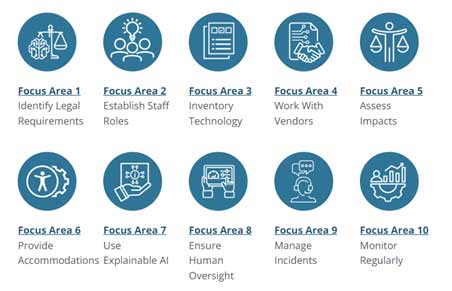 Details of the guidance’s 10 focus areas from framework publisher: Partnership on Employment & Accessible Technology.
Conform to the ethical boundaries
The release of this framework should serve as a reminder that AI continues to be a primary focus for regulators and that, even as AI and other new technologies become standard, it is essential to uphold fairness in the recruitment process. Employers should review the framework and cross-check it with your company’s policies and training on AI-enabled hiring tools. Understanding this framework will help employers stay aligned with current governmental expectations and future regulations on responsible AI use.

