
A featured contribution from Leadership Perspectives, a curated forum for enterprise technology leaders, nominated by our subscribers and vetted by the CIOApplications Editorial Board.

CrowdFlower
CEO to CIO: "What's our AI Strategy?"

Debunking Common AI Myths
The media coverage of AI has led to oversimplification and sensationalization of a complex and nuanced topic. So we need to debunk the two most pervasive myths before we can establish a sensible framework.
Myth 1: AI = Machines > Humans
For the last 30 years, the media has loved portraying AI as the replacement of humans by machines, whether it’s Schwarzenegger in the Terminator or Alicia Vikander in Ex Machina. This is the wrong mental model for AI in the enterprise. The right framing is to think of how machines can augment humans, not replace them. Even the recent media coverage of Google’s DeepMind/ AlphaGo victory over Lee Sedol was simplistically portrayed as ‘Machine defeats Human.’ The more accurate description would be Machine plus many Humans defeats single Human.
Machines have advantages that Humans do not: speed, cost, and consistency. Humans have advantages that Machines do not: task complexity and breadth of task capability. The challenge is to find the right way to blend Humans and Machines, not replace Humans with Machines.
Myth 2: AI = Best Algorithm
Many people believe that AI and algorithm are one and the same; that the best algorithm creates the best AI solution. Facebook has the best newsfeed algorithm, Netflix has the best movie recommendation algorithm and Google has the best ad placement algorithm.
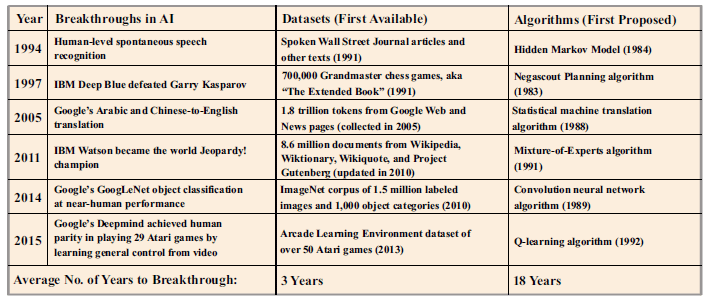
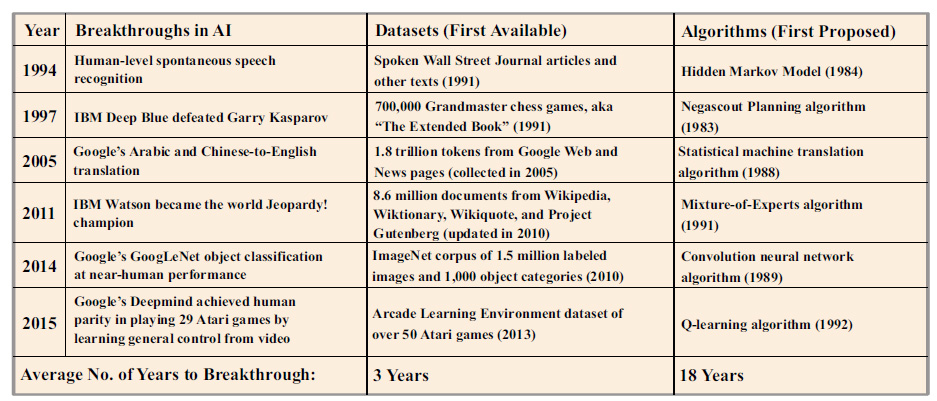
We think this is incomplete. AI and algorithm are not synonymous terms. Algorithms are a necessary component of AI, but only that– a component. Many leading experts such as Alexander Wissner-Gross now claim data – and not algorithms – is the key limiting factor to the development of human-level artificial intelligence. He reviewed the timing of the most publicized AI advances over the past 30 years.
The challenge is to find the right way to blend Humans and Machines, not replace Humans with Machines
His evidence suggests that even with the algorithms available, it wasn’t until high-quality training data sets became available that the major AI breakthroughs were able to come to fruition.
The AI Equation for the Enterprise
We believe there is an essential equation that the CIO needs to understand if AI is to be a commercial success inside an enterprise. This equation reflects that there are not one but three necessary components to making AI working in the enterprise.
AI = TD + ML + HITL
So let’s break it down and imagine a company is trying to create an AI solution that can categorize customer support tickets by severity level. The categorization is based on the unstructured text showing an exchange between a customer and a customer support rep discussing a particular topic or problem within the support ticket.
TD is Training Data:
Training Data is a set of inputs with the correct outputs or examples with the correct labels that can be used as an example to train the Machine. In this example, the input is the unstructured text inside a support ticket. The outputs are the labels “topic” and “level of importance” which has been applied by Humans in accordance with definitions from the specific company in question. An automotive manufacturer will want to define these topics and levels of importance differently from a retail banker or a wearable technology company.
ML is Machine Learning:
The Machine Learning capability is the ability to convert Training Data into a predictive model that can be applied to new inputs – in this case, new support tickets with unstructured text. You want the Machine Learning model to apply its predictive power to create new outputs – in this case, the labels “topic” and “level of importance”. One of the advantages of Machines compared to Humans is their ability to understand their own confidence level. Humans are notoriously overconfident at evaluating their own judgments. So you can accept or reject the prediction based on the Machine’s own assessment of its confidence level. For example, if a support ticket has words and phrases which haven’t been seen in the Training Data, or seen very infrequently, then the Machine will objectively assess its own confidence level as being low for that particular prediction.
HITL is Human- In-The-Loop:
This is the critical third component of commercially viable AI. If the Machine Learning model is not confident in its prediction, it can route it to humans to review and answer. In this blended model, you take advantage of the speed and scale of Machine Learning to address the less difficult tasks, while the humans handle the harder tasks. This allows imperfect algorithms to fail safely, and for the business to generate business value even while the algorithm is imperfect.
So if you want to be ready to answer the question “What’s our AI strategy?” from your CEO, pick your first business process that requires human judgment today, and start thinking about the three components of this framework.

